|
|
| (5 intermediate revisions by 2 users not shown) |
| Line 2: |
Line 2: |
| {| | | {| |
| [[Datei:About-the-proj.jpeg|verweis=]] | | [[Datei:About-the-proj.jpeg|verweis=]] |
| <div class=gm-banner-text> | | <div class="gm-banner-text"> |
| ==Description of Global Migrate== | | ==Description of the Project== |
| </div> | | </div> |
| |}</div>''To create a practical European model for integrating migrants and refugees (EMI), the theoretical model of social reality by George Ritzer, named after its creator (Method Modelling Social Systems and Phenomena), was used. At its most basic, this model of social reality offers a perspective based on the interconnection between four factors: individuals, society groups and society, culture and governmental institutes. The model operates with the notion of Macro subjective and Micro subjective, Macro objective and Micro objective levels of interaction, giving an insight into how people interact with each other and the world around them, describing critical aspects of social life such as social interdependence, social roles, social norms and values, and social institutions, and provides tools and concepts for analysing social processes, and phenomena. However, this meta-model is general and has yet to be applied as a practical tool. The practical use of the model for understanding and modelling the processes of integrating migrants and refugees is used for the first time. It is one of the undoubted achievements of the project. To better understand the use and validation of this model for a description of such a social process as integration, the project team contacted George Ritzer, and there was an in-depth discussion and a Q and A session online on the model's applicability and its innovation.'' | | |}</div> |
|
| |
|
| ''Working with the model, an international team of academics from the relevant field was involved through online sessions and physical meetings to validate the relevance of such an approach. The main task in creating the European Model for the Integration of Migrants and Refugees (EMI) was to create a system of interrelated sub-issues/micro-themes that adequately described this process. A variety of steps were undertaken to ensure the relevance of the questions.'' | | ''The project «From intention to implementation based on European know-how», 2021-1-DE02-KA220-ADU-000035919 takes place from 1/02/2022 until the 31/08/2024 and is supported by the program ERASMUS+ Partnership for cooperation in adult education.'' |
|
| |
|
| ''The beginning of the creation of the model can be considered the streamlining of one’s knowledge and experience of communication with migrants and refugees in their countries by the project partners. During mobility, the partners created the model through continuous discussion, both remotely and in person (Discussion Method). The on-site training for project participants of the nature “We are building a society” - 3 Days of Staff and Learners Training (Method Ecopsychology and Expressive Art) allowed the multilingual working group to reach the high level of solidarity necessary for teamwork, understanding the complexity of the upcoming work and allowed mapping the use of such a model and increased the level of motivation of the participants in the project and gave them the understanding of the common goal. Throughout the project, the analysis method of documents in six languages was used to study official documents, statistical data, reports and studies on migration and refugees. The use of the technique of Documentary Analysis allowed us to enrich our ideas and sometimes correct them significantly.'' | | ''The multidisciplinary team of project partners from Italy, Portugal, Bulgaria, Norway, Ireland and Germany analyses the integration process of migrants and refugees in the project "From intention to implementation based on European know-how" at national level, using the four levels of George Ritzer's theory.'' |
|
| |
|
| ''To better understand the current situation, a sociological study of the problem was carried out, structured interviews and surveys were conducted with migrants and refugees, and their behaviour was observed when addressing integration issues in different EU countries. Sociological research methods, questionnaires, structured interviews, surveys, and observations gave a rich basis for a comparative analysis of the behaviour of migrants and refugees in different countries and regions. The Comparative Analysis Method made it possible to identify general trends, differences, and features in approaches to integration and problem-solving. To gain an in-depth understanding of the individual and collective aspects of their problems, case studies were applied to enlighten the concrete issues of migrants and refugees. The focus group method was used to gain insight into common trends, opinions, experiences, and the most pressing integration problems. In addition to seminars and group meetings with migrants and refugees, a series of conversations and consultations were held with experts on integrating migrants and refugees. Lawyers, sociologists, psychologists, etc., provided valuable information for drawing up the foundations of our EMI (Expert Interview Method) model.'' | | ''As a result of this project, we offer an EMI model of European integration of migrants and refugees as a European guideline for an integration process (EMI: European Model of Integration).'' |
|
| |
|
| ''Using these methods and approaches, sub-questions/sub-themes were formulated, which formed the conceptual basis for modelling the process of integrating migrants and refugees into the EU.'' | | ''The EMI can help to understand the complexity of the integration process, to compare European countries at the personal (micro-subjective), social (micro-objective), cultural (macro-subjective) and governmental (macro-objective) levels, to enable and compare integration practices in Europe. This, in turn, can contribute to a more precise identification and understanding of country-specific resources and deficits. The EMI provides an overview of good functioning and educational practices.'' |
|
| |
|
| ''The proposed sub-questions/micro-topics were distributed across the four levels of Ritzer's model: Micro-subjective, micro-objective, macro-subjective, and macro-objective. This made it possible to determine the social connections that migrants and refugees form in a new country and how these connections influence their impact on integration, how migrants and refugees accept and adapt to social roles in EU countries, how successfully they integrate and what barriers prevent them. Using Ritzer's model for our purposes in the context of integration processes shows the influence of social norms, culture and values on people's behaviour. Studying how migrants and refugees accept and adapt to social norms and values in EU countries helps to identify factors that facilitate or hinder their integration process. Based on the Ritzer Model, the EMI model also considers the role of social institutions, such as education, health care, economic and political institutions, and cultural institutions, in forming social reality. Examining how these institutions interact with migrants and refugees and with one another identifies opportunities and barriers to their integration in EU countries.'' | | ''The project had several objectives.'' |
|
| |
|
| ''The proposed EMI integration model is standard for all EU countries and can be used for mapping and optimising the understanding of the efficiency of integration. Moreover, its applicability and practicality were tested and approved in the six countries participating in the project, as evidenced by each national integration model of the corresponding country proposed in the project and presented in its national models. It can also be used to gain an understanding of the resources of the countries as well as the blind side. This gives information about the institutions and factors involved in the integration process and the value of interaction between them. The conclusion in all the national models is based on a series of comparative discussions and has given us an understanding of the positive resources that migrants and refugees might find in the integration process in each country.'' | | ''On the one hand, we offer a modern set of tools to identify the resources needed for successful integration. On the other hand, it's about raising awareness and understanding of the integration process based on concrete examples from the partner countries Germany, Bulgaria, Italy, Ireland and Norway. In addition, it's about support/creation of a platform for European networking of selected national actors working on the four levels analysed according to George Ritzer's theory.'' |
| | |
| | ''The EMI model is intended to be used for training purposes by organisations involved in the integration process of immigrants and refugees in European countries.'' |
| | |
| | ''We organised a workshop at the beginning of the project to get a feel and understanding for working with the integration model. And we are proud and happy to say that we have already received positive feedback on the use of our model with different groups of migrants.'' |
| | |
| | ''A total of 7 transnational project meetings were organised and held during the project. The project meetings alternated between the project partners and were organised by the respective project partner.'' |
Description of the Project
The project «From intention to implementation based on European know-how», 2021-1-DE02-KA220-ADU-000035919 takes place from 1/02/2022 until the 31/08/2024 and is supported by the program ERASMUS+ Partnership for cooperation in adult education.
The multidisciplinary team of project partners from Italy, Portugal, Bulgaria, Norway, Ireland and Germany analyses the integration process of migrants and refugees in the project "From intention to implementation based on European know-how" at national level, using the four levels of George Ritzer's theory.
As a result of this project, we offer an EMI model of European integration of migrants and refugees as a European guideline for an integration process (EMI: European Model of Integration).
The EMI can help to understand the complexity of the integration process, to compare European countries at the personal (micro-subjective), social (micro-objective), cultural (macro-subjective) and governmental (macro-objective) levels, to enable and compare integration practices in Europe. This, in turn, can contribute to a more precise identification and understanding of country-specific resources and deficits. The EMI provides an overview of good functioning and educational practices.
The project had several objectives.
On the one hand, we offer a modern set of tools to identify the resources needed for successful integration. On the other hand, it's about raising awareness and understanding of the integration process based on concrete examples from the partner countries Germany, Bulgaria, Italy, Ireland and Norway. In addition, it's about support/creation of a platform for European networking of selected national actors working on the four levels analysed according to George Ritzer's theory.
The EMI model is intended to be used for training purposes by organisations involved in the integration process of immigrants and refugees in European countries.
We organised a workshop at the beginning of the project to get a feel and understanding for working with the integration model. And we are proud and happy to say that we have already received positive feedback on the use of our model with different groups of migrants.
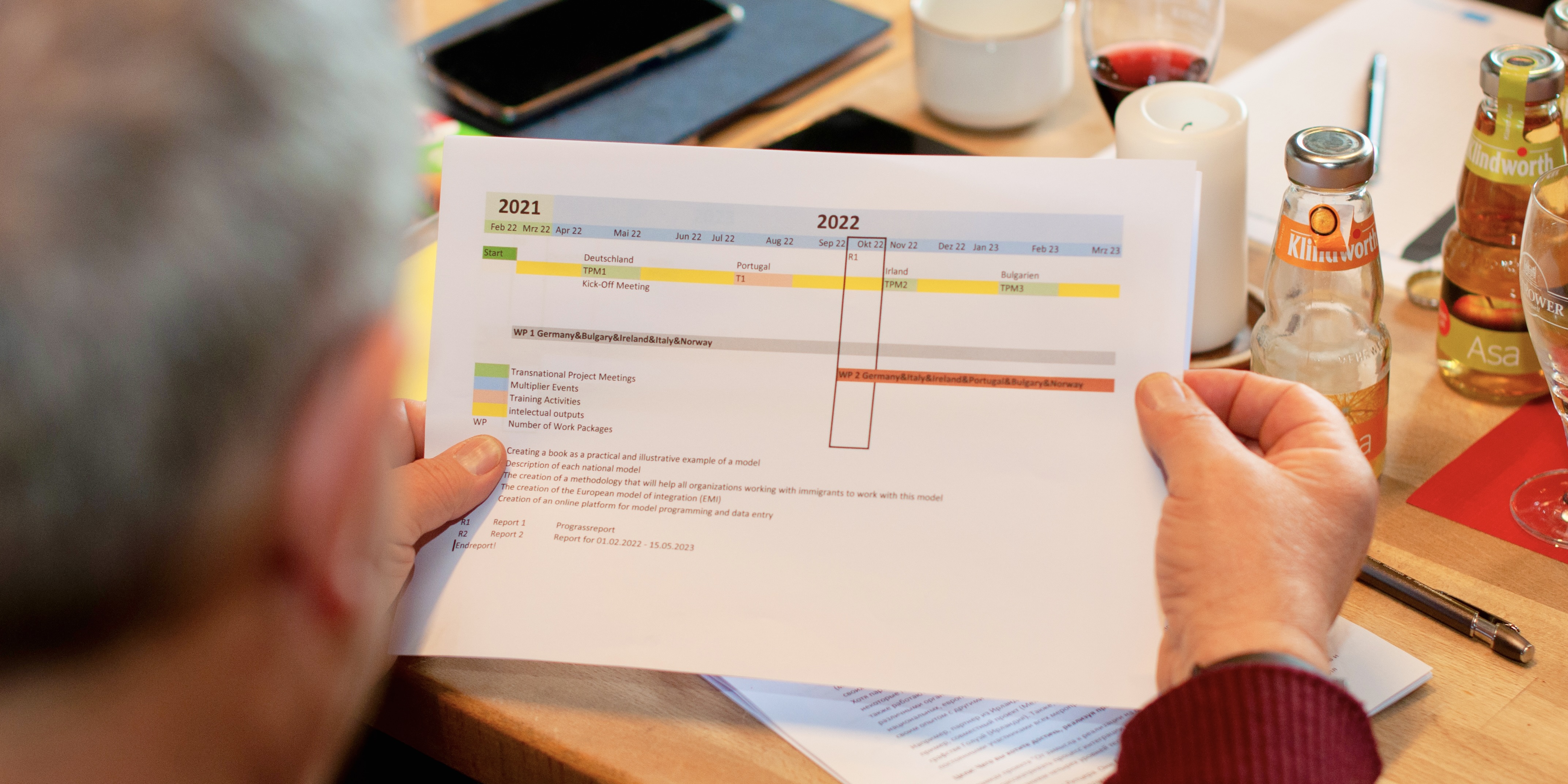
A total of 7 transnational project meetings were organised and held during the project. The project meetings alternated between the project partners and were organised by the respective project partner.
